
APPLICATIONS
Where our geotextiles are specified
Every application combines several functions. Grammage is selected from the mechanical stress during installation and from the hydraulic requirements.
HOW IT WORKS
Seven functions, one sheet of fabric
Every project uses some combination of these. The function decides the grammage, not the other way round.
1Separation
Keeps two dissimilar materials from mixing. Aggregate above stays out of the soft subgrade below, so the platform keeps the thickness it was designed with.
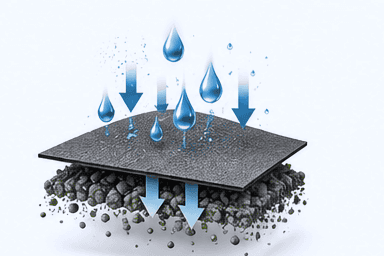
2Filtration
Passes water, holds soil back. Water crosses normal to the plane while fine particles are retained, so the drain behind it does not silt up.
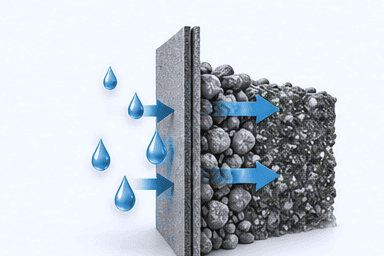
3Drainage
Carries water along its own plane. A thick needle-punched felt acts as a conduit, moving water sideways to an outlet.
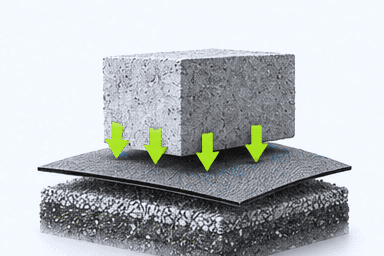
4Protection
A cushion against mechanical damage. Over a geomembrane it absorbs point loads from angular fill, during installation and in service.
5Reinforcement
Adds tensile strength to soil. Friction and adhesion between fabric and fill resist the tensile and shear forces the ground cannot take alone.
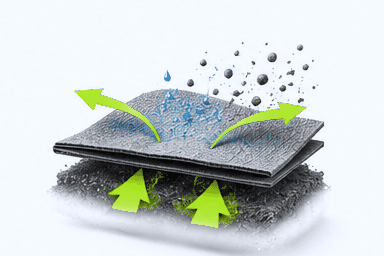
6Erosion control
Holds the soil surface against moving water. On slopes and channel banks it resists the tractive force of flow and of rainfall.
7Stress relief
Interrupts reflective cracking. As an interlayer between old pavement and overlay it delays cracks travelling upward and sheds surface water.
Function diagrams. The geotextile is the dark sheet; the forces acting on it are picked out in lime.
01
Roads and sub-base
Placed between a deformable subgrade and the sub-base, the geotextile stops the two materials from intermixing. Bearing capacity is maintained, aggregate thickness is reduced and pavement service life increases.
Reference standards
Recommended grades
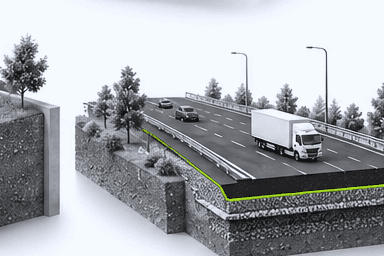
- 1Granular layer
- 2Taltex geotextile
- 3Subgrade
- Separation
- Filtration
- Reinforcement
- Stress relief
02
Filtration and drainage
As a drain wrap, trench filter or drainage blanket, the geotextile lets water through and holds fines back. Selection is driven by the O90 opening size read against the grading of the soil.
Reference standards
Recommended grades
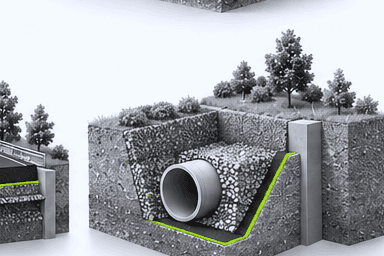
- 1Drainage fill
- 2Taltex geotextile
- 3Fine soil
- Filtration
- Drainage
- Separation
03
Erosion control
Beneath bank rip-rap or a revetment, the geotextile stops fine particles being carried away by currents and water table movement, while letting water pass freely.
Reference standards
Recommended grades
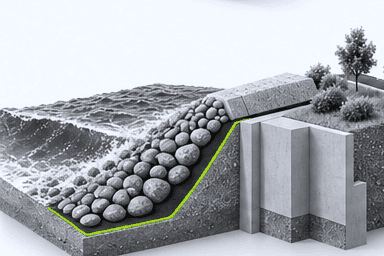
- 1Rip-rap
- 2Taltex geotextile
- 3Bank
- Erosion control
- Filtration
- Separation
04
Landfill and containment
As a cushion layer above and below the geomembrane, the geotextile absorbs puncture loads from aggregate and waste. Heavy grades, 500 to 1200 g/m², are the reference for this duty.
Reference standards
Recommended grades
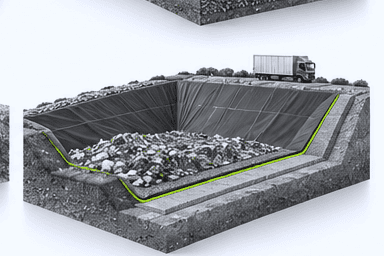
- 1Drainage layer
- 2Taltex geotextile
- 3Geomembrane
- Protection
- Separation
- Drainage
05
Reinforcement and retaining walls
Laid in horizontal sheets, geotextile layers carry the tensile forces within the fill. Design is governed by tensile strength and by elongation at maximum load.
Reference standards
Recommended grades
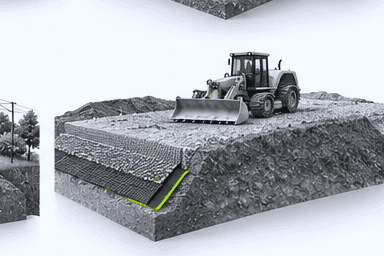
- 1Compacted fill
- 2Taltex geotextile
- 3Compressible soil
- Reinforcement
- Separation
06
Hydraulic works
In canals, storage basins and dykes, the geotextile provides filtration under the lining and protects the waterproofing. It withstands repeated wetting and drying cycles.
Reference standards
Recommended grades
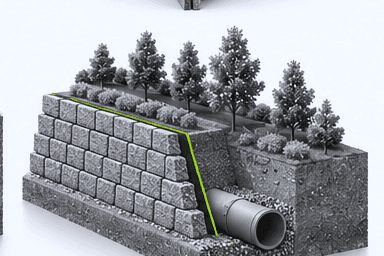
- 1Lining
- 2Taltex geotextile
- 3Formation level
- Filtration
- Protection
- Separation
WORKING WITH US
How a project runs
Most of the value is decided before the first roll is delivered. We are involved from the specification through to placement on site.

01
Specification
We take the ground conditions and the function required, and propose a grammage and roll width against the applicable EN ISO standards.

02
Quotation
A costed proposal with quantities, roll dimensions and lead time, so the tender can be priced without guesswork.

03
Site survey
Where it earns its place, a visit to confirm ground conditions, access and how the rolls will be handled and stored.
04
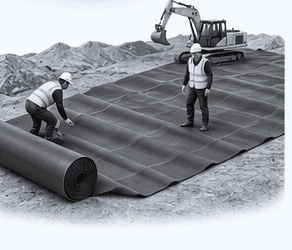
Delivery and placement
Rolls are labelled by batch and delivered to the programme. We advise on overlaps, anchoring and protection during placement.
A site to specify?
Tell us the function you need, the grammage you have in mind and the quantities. We reply with the datasheet and a roll width proposal that fits.